
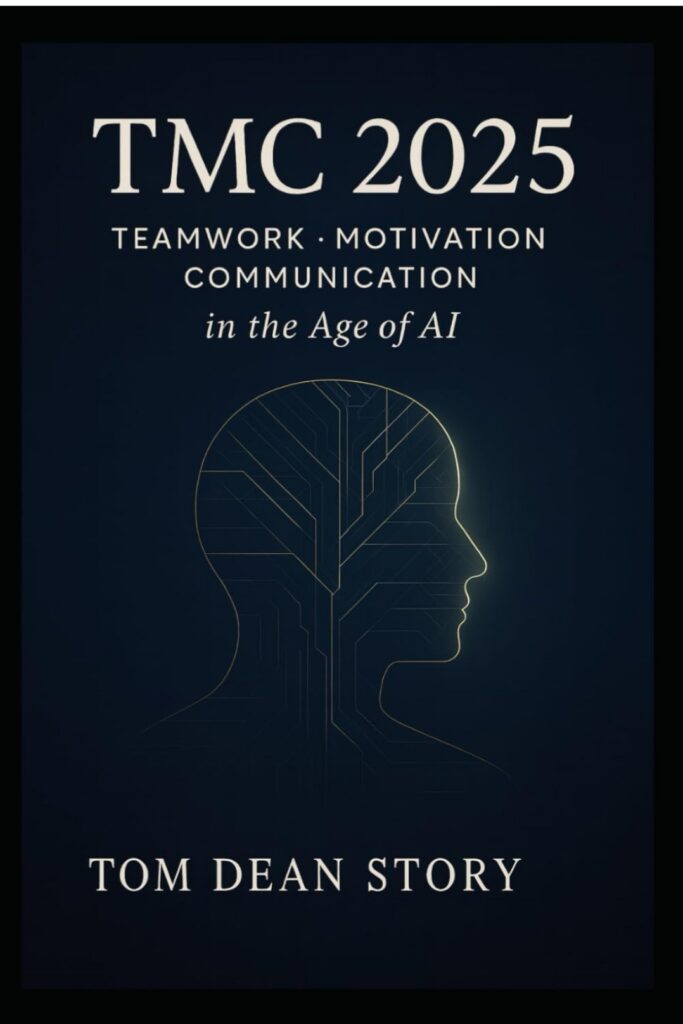
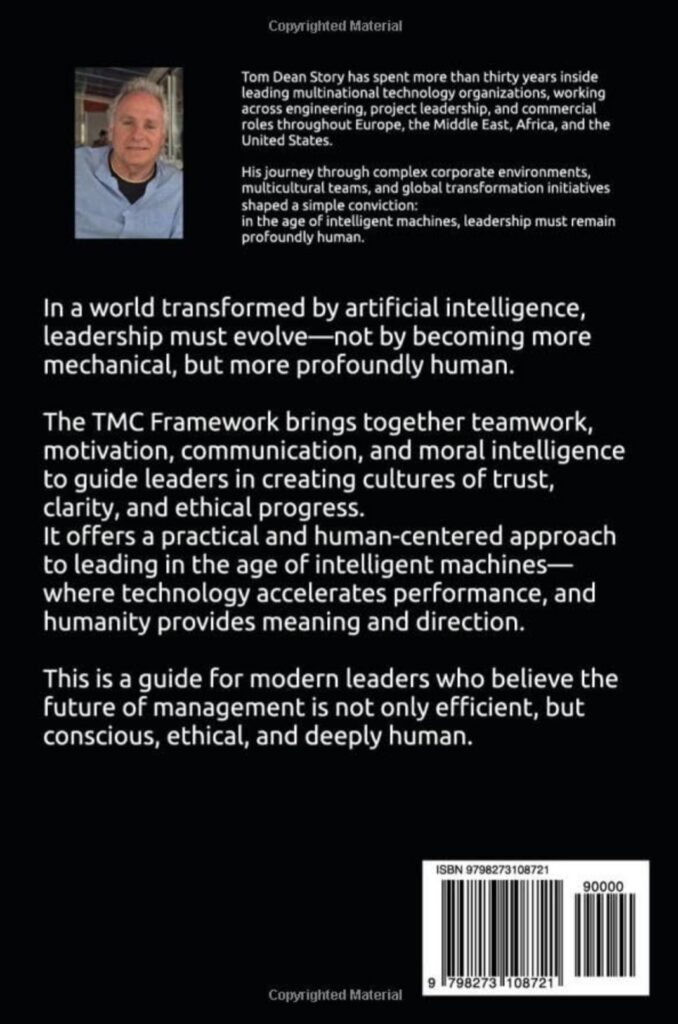
This annex does not introduce a different model, nor does it replace TMC’s original formula. It extends it and tests it against business history.
The TMC Index continues to measure an organization’s internal health through the relationship between Teamwork, Motivation, Communication, and friction. The Impact formula observes a complementary dimension: the quality of the intelligences operating within that system, and the ethical direction of its decisions.
An organization may have talent, technology, and resources, and still fail to convert them into sustainable progress if friction blocks its capacity to act, or if moral intelligence stops guiding its decisions.
The cases that follow do not claim to rate companies in absolute terms. Each one represents a snapshot taken at a given moment, using the formula as an interpretive lens: a way of observing how human talent, technology, moral awareness, and friction can combine to produce transformation, stagnation, or a loss of direction.
Introduction
TMC was born in 2011 from a simple question: what keeps an organization alive once processes alone are no longer enough?
The answer, back then, was a triangle — Teamwork, Motivation, Communication — held up by a single condition: reducing the friction that separates people from their best version.
Fourteen years later, that triangle is still the heart of the model.
But the world around it changed.
Artificial intelligence entered every process, every decision, every team.
And TMC had to ask itself a new question, bigger than the first: what keeps an organization alive when the machine also thinks?
This annex is born from that question. You don’t need to have read the rest of the book to follow it — it’s enough to know that TMC has believed one thing from the start: technology can accelerate any process, but only people can give it direction.
That is the thread running through every page of this work, and through every book this author has written before it: the certainty that no tool, however powerful, replaces the human question of what for.
This annex puts that thread to the test with real cases. Not with theory — with history.
The Formula: Impact
The TMC model expanded across three horizons, each stage preserving the one before it while adding a new dimension of analysis.
In 2011 it was
TMC Index = (T × M × C) / f
the health of a team.
Later, as artificial intelligence entered the equation, it became a leadership formula:
(HI + AI) × XQ / f.
And in its final horizon — the one this annex develops — it became a measure of footprint: not just how an organization leads, but what impact it leaves on the world.
The Impact formula does not replace the TMC Index. Both models observe different dimensions of the same organization. While the TMC Index measures the health of the human system through teamwork, motivation, and communication, Impact evaluates how human intelligence, artificial intelligence, and moral intelligence determine the quality and sustainability of the decisions that system produces.
Impact = [(HI + AI) × XQ] / f
Numerator
➢ Human Intelligence (HI): judgment, empathy, the capacity to adapt. Everything a person brings that no machine can fully replicate.
➢ Artificial Intelligence (AI): speed, processing power, scale. A real force — but incomplete without direction.
➢ Moral Intelligence (XQ): the compass. The capacity to tell right from wrong and act with integrity, transparency, and responsibility. It is the factor that multiplies, not adds: without XQ, neither talent nor technology produces anything that lasts.
Denominator
➢ Friction (f): everything that slows things down — fear, ego, bureaucracy, bias, misalignment. And, at times, an attack that comes from outside and isn’t chosen.
Since artificial intelligence entered the model, HI and AI are no longer understood as independent forces but as complementary intelligences.
The sum expresses that collaboration: neither replaces the other; together they expand the capacity to decide.
Multiplying by XQ raises the whole equation, because only when ethical judgment runs through both human and automated decisions does the outcome become sustainable.
And dividing by friction acknowledges what every organization discovers sooner or later: the brightest talent and the most advanced technology can still be paralyzed by a culture that doesn’t trust itself.
This is not a formula of efficiency. It is a formula that forces a «should we» before every «can we» — and that second question is the one that truly multiplies the result.
Relevance of the formula in the twentieth century: success does not protect you from your own cracks
No company in the twentieth century knew this equation while it was living through it. And yet, all of them lived it.
IBM is, perhaps, the case that best teaches that not even market leadership immunizes against the formula.
By the late 1980s, IBM dominated the mainframe world with a near-monopoly position.
But in 1993 it posted an annual loss of $8 billion — the largest corporate loss in history up to that point — with revenue falling from $69 billion in 1989 to $62.7 billion in 1993.
It had HI to spare — engineers, science, decades of accumulated knowledge in its research labs — and it had technology to spare: the technology remained cutting-edge.
What it lacked was the recognition that its own internal friction, a bureaucracy that believed itself untouchable, no longer let talent or innovation flow.
Wall Street wanted the company broken into pieces.
Lou Gerstner, an executive with no prior technology experience, did the opposite: he kept the company together, aggressively cut prices no one dared touch, and laid off nearly 100,000 employees to make what remained sustainable.
Thirty years later, IBM is a $61.9 billion company with leadership positions in hybrid cloud and artificial intelligence infrastructure.
The formula didn’t change: only who dared to reduce the friction did.
It wasn’t the only case.
Kodak invented the digital camera in 1975 and didn’t launch it for fear of cannibalizing its own film business — the most-cited example of friction that is born from within and carries no expiration date.
Today it employs around 3,400 workers, down from 140,000 at its peak.
Lucent Technologies, heir to Bell Laboratories, was in 1999 the largest telecommunications company in the world, with 153,000 employees; seven years later it had lost more than 75% of its revenue for failing to translate its technical edge into a viable business model.
Motorola, which invented the commercial mobile phone, failed to compete with the hardware-software integration the iPhone brought in 2007 — and had to split in two just so one half could survive.
Symbol Technologies, a pioneer of the barcode scanner, had HI and technology to spare, but an accounting fraud that inflated revenue by more than $230 million sank its XQ from within.
And Blockbuster, Sears, and Nokia share the same final lesson: size and past success guarantee nothing once a single variable in the formula collapses and no one corrects it in time.
The pattern is always the same: success is not a vaccine. At most, it’s a truce.
Today’s companies and their relationship with the formula
Today, the same equation is playing out in real time, across companies of every size and sector.
Mercadona closed 2025 with revenue of €41.858 billion, growth of 8%, and net profit of €1.729 billion, 25% higher than the previous year, while creating 5,000 new jobs.
It combines growing automation with a workforce that is mostly permanent, and a visible social response to crises such as the DANA floods: HI, AI, and XQ advancing together, with friction at a minimum.
Costco has built its success on the one variable almost no company its size dares to protect: XQ. It pays its U.S. and Canadian workforce an average wage above $31 an hour, well above the industry, and holds an employee retention rate near 93%.
It closed fiscal year 2025 with $269.9 billion in net sales, up 8.1%. Paying well and growing fast are not opposites: they are, in fact, the same decision.
Microsoft, by contrast, shows the formula’s incomplete face: its cloud business surpassed $168 billion in revenue, up 23%, in the same year it laid off more than 15,000 people, citing AI’s success as part of the reason. HI and AI are working flawlessly.
What’s missing is the question «should we?» — and its absence goes unnoticed until it has already cost something.
Boeing, after the 737 MAX accidents, is going through what analysts call an era of reconstruction: it reopened a fourth production line and regained authority to issue airworthiness certificates, but its recovery depends on whether that discipline survives renewed commercial pressure.
Other companies — F5, Inc. among them — show a different variant of the formula: friction that isn’t born inside, but arrives from outside.
In October 2025, F5 suffered persistent access by a state-linked actor to its development systems. Its response — immediate transparency once it could speak, independent audits, reinforced investment in security — is a simple reminder: when HI, AI, and XQ were already aligned before the crisis, external friction gets absorbed; when they weren’t, it becomes the end of the story, as happened to Symbol or Lucent.
Unisys and NCR, meanwhile, show the quietest variant: no scandal, no collapse, just the slow friction of an inherited structure that never quite lets go. None of these stories is closed yet.
Companies of the future: when ethics becomes infrastructure
The next chapter of the formula is already being written, and it isn’t being written by the biggest companies, but by the ones that first turned «should we» into a measurable process.
In 2026, organizations with formal AI governance frameworks — certifications such as ISO 42001, ethics committees with multidisciplinary representation — report up to five times more trust in their business relationships, and 43% fewer documented incidents of algorithmic bias.
An AI incident without governance — a bias, a leak, a wrong decision — costs on average $2.1 million in reputational damage and litigation.
A governance framework costs less than 5% of that.
The reading, in the language of this formula, is direct: the companies of the future won’t be the ones with the most AI, but the ones that turned their XQ into infrastructure — into a committee, an audit, a repeatable process — before friction forced them to improvise it in the middle of a crisis.
Ethics, during the twentieth century, was a personal virtue of a few leaders. In the twenty-first century, it is slowly becoming a line on the balance sheet.
Conclusion: the formula fifty years from now
None of the companies in this annex read the equation before living it.
IBM didn’t know its bureaucracy had a variable’s name;
Kodak didn’t know its fear had one either;
Costco didn’t know it was proving, with numbers, that paying well is profitable.
That is, perhaps, the most honest lesson this journey leaves behind: the formula isn’t applied from the outside.
It describes what is already happening inside any organization, whether or not anyone knows how to measure it.
What will happen fifty years from now, when HI, AI, and XQ stop being three separate forces and simply become one single way of operating?
This author believes the companies that survive won’t be the biggest, or even the most technological.
They will be the ones that learned, long before the law or the market demanded it, that intelligence without conscience is speed without direction.
The organizations of the future won’t ask themselves whether they use artificial intelligence — all of them will.
They will set themselves apart by one thing only: whether, underneath that intelligence, there is still someone asking what for.
Friction will never disappear entirely. But the organizations that reduce, year after year, their fear, their ego, and their bureaucracy will discover the same thing Mercadona, Costco, and IBM discovered in their own moment of reinvention: that the numerator only matters if the denominator is cared for first.
Disclosure statement
All financial data, corporate facts, and statements cited in this document come from public sources: earnings releases, filings with regulators (SEC, FAA), and verifiable specialized press coverage as of the dates indicated.
No confidential, leaked, or restricted-access source has been used.
The use of the names, trademarks, and logos of the companies mentioned (IBM, Mercadona, Costco, Microsoft, Boeing, Kodak, Lucent Technologies, F5 Inc., Unisys, NCR, Symbol Technologies, Motorola, Blockbuster, Sears, and Nokia) is purely referential and descriptive (nominative use): it identifies the company being discussed, without suggesting in any way sponsorship, affiliation, endorsement, or business relationship between those companies and the author, the book TMC, or Siempre Juntos.
The annex analyzes facts already publicly disclosed by the companies themselves or by accredited press, and interprets them under the author’s own conceptual framework (the Impact formula).
The assessments made through the Impact formula represent the author’s interpretation, based on the TMC conceptual framework, and do not constitute an official, financial, or legal evaluation of the organizations analyzed.
This interpretation constitutes commentary and analysis — protected as an expression of opinion and criticism — and not an assertion of unverified facts.
No accusation of fraud, misconduct, or malpractice is made on the author’s own initiative: in the single case where unlawful conduct is mentioned (Symbol Technologies), the reference points directly to a public U.S. SEC enforcement action, already resolved and in the public domain since 2004.
No figure has been invented, extrapolated beyond what the source reports, or presented outside its temporal context. Where a company has clarified or corrected a news item, that clarification is included.
Source within the TMC book itself
The Impact = [(HI + AI) × XQ] / f formula, its name, and the closing line — «Technology accelerates progress. Humanity gives it meaning.» — come directly from the author’s own manuscript: TMC Framework 2025 — The Human Framework for the Age of Artificial Intelligence (Tom Story, 2025), chapter 5.2–5.3.
«Technology accelerates progress. Humanity gives it meaning.»