
What humanity has already learned to adapt to — and what it risks forgetting again
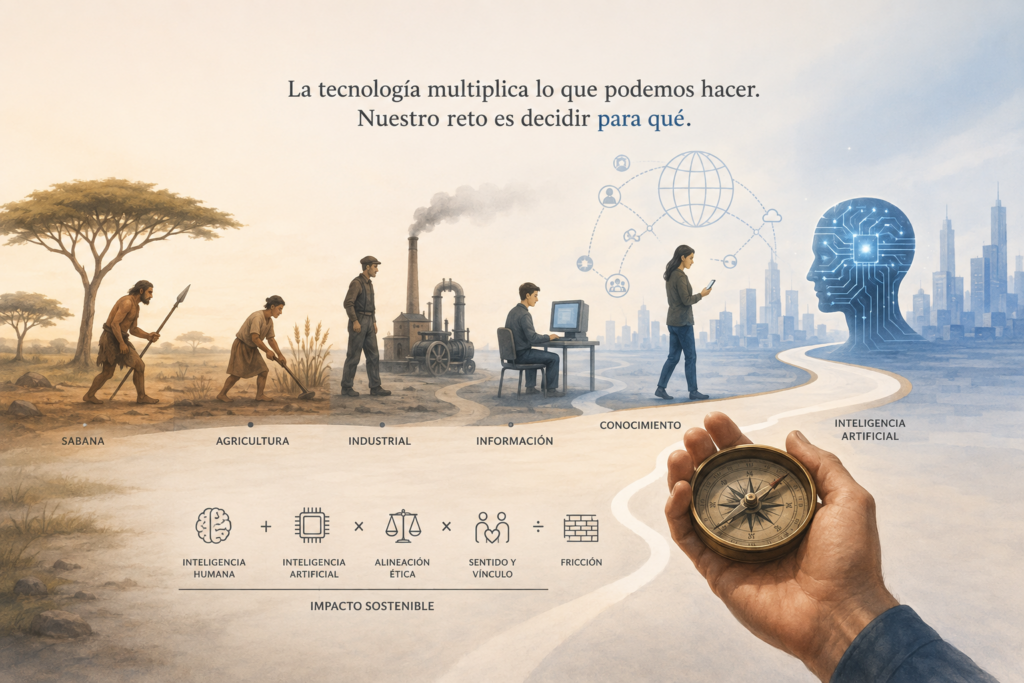
Humanity has successively outsourced its strength, its memory, its calculation, and its connection; now it is outsourcing part of its intelligence.
But the real challenge was never technological — it’s human: sustaining and strengthening judgment — the capacity to decide where to direct all that power — so that progress doesn’t collapse into concentration or dehumanization.
There is a thread that runs through all of human economic history, and once you see it, you can’t unsee it: every time a new technology multiplies what a single human being can produce, society takes generations to learn how to share that surplus without breaking apart in the process.
That is the thread this essay follows. It isn’t a curiosity from the past — it’s the exact pattern we’re entering right now with artificial intelligence.
Recognizing it in time is the only real advantage one generation has over the last.
I. The Historical Foundation: When Growing Meant Surviving
I wrote my first web page in HTML — with a flying dove GIF, because that was cutting-edge technology at the time.
It didn’t take long before JavaScript and dynamic pages took over. I had to buy new books and learn a different way of programming almost before I’d finished mastering the last one.
That memory, small and personal, is the starting point of this essay: the feeling that the moment you learn a tool, the next wave is already breaking. Not as historical abstraction, but as something lived in the first person, again and again.
For 95% of the time humanity has existed on Earth, growing didn’t mean what it means today.
Hunter-gatherer bands measured their prosperity in territory and in the number of mouths they could feed without exhausting their surroundings.
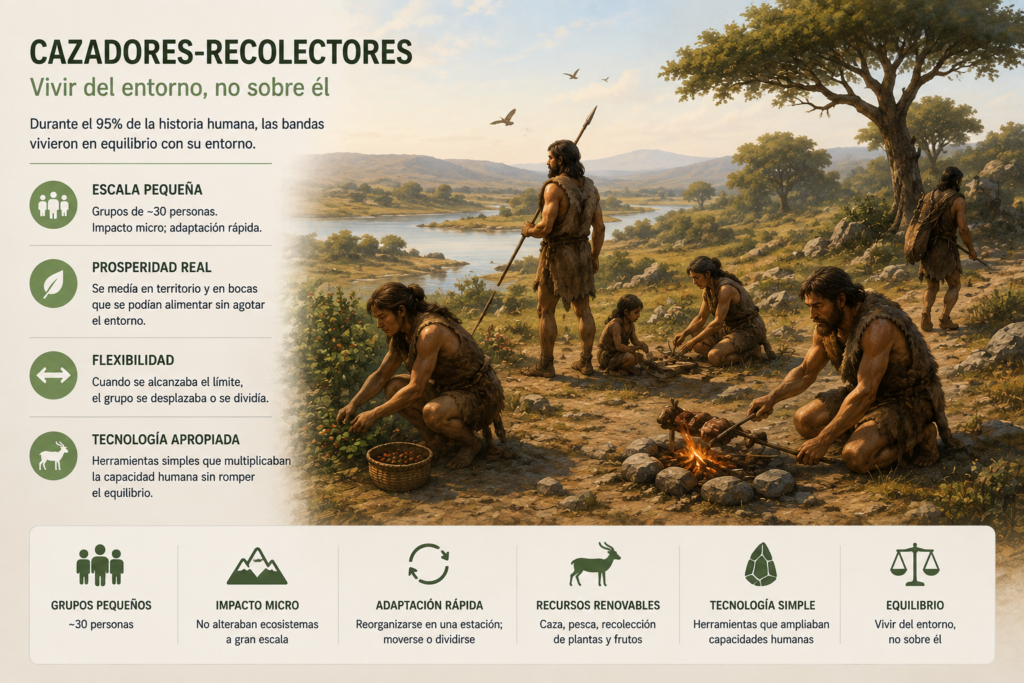
Figure — Hunter-Gatherers: living within their environment, not beyond it. Small bands (~30 people), micro-scale impact, rapid adaptation, renewable resources, simple tools, balance.
These were activities that could barely be intensified, so when a group approached that ceiling, it didn’t produce more — it moved, or it split.
The impact was entirely micro — the band, not some larger entity. And adaptation, when needed, was fast precisely because the scale was small: a group of thirty people can reorganize in a season; an entire civilization cannot.
The agricultural revolution, roughly eleven thousand years ago, changed the very nature of growth.
For the first time, production could be intensified, and the surplus meant not everyone had to produce food — the artisan, the merchant, the priest were born.
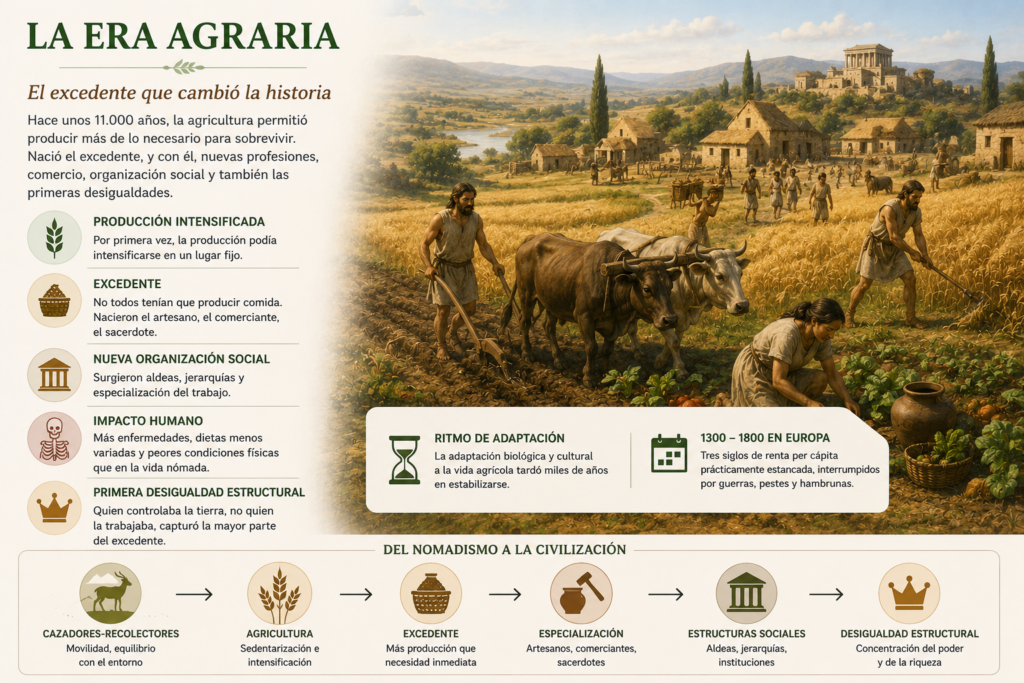
Figure — The Agrarian Era: the surplus that changed history. From hunter-gatherers to intensified production, surplus, specialization, social structures, and structural inequality.
But the macro impact took millennia to fully unfold, and the micro impact was brutal from the start: settled life brought new infectious diseases, poorer diets, and — according to much of the archaeological evidence — smaller, worse-nourished skeletons than those of the hunter-gatherers it replaced.
Biological and cultural adaptation to agricultural life — new food, new diseases, new social hierarchy — took, literally, thousands of years to stabilize.
Between 1300 and 1800, much of Europe lived with per capita income essentially flat: three hundred years of plateau, interrupted by wars, plagues, and famines that kept dragging the system back to something close to where it started.
That was the normal rhythm of the agricultural world. And with it comes the first lesson of the thread: surplus also created history’s first structural inequality. Whoever controlled the land — not whoever worked it — captured most of the gain.
II. The Last Two Hundred Years: Impact, Adaptation Time, and the Psychological Cost of Change
Here the clock accelerates in a way no previous generation had experienced. Innovation economics has a technical name for what happens every time a technological revolution arrives: techno-economic paradigm.
The researcher who has documented this most thoroughly observed that every great technological wave splits into two periods of twenty to thirty years each.
An installation period, when the new technology bursts in and destabilizes the old order. And a deployment period, when society finally rebuilds its institutions — labor laws, education systems, safety nets — to absorb the new technology.
Between one phase and the next there is what she calls a «turning point»: a crisis, almost always financial and social at once, that forces the readjustment because the old institutional framework can no longer hold.
This isn’t an isolated opinion — today it’s one of the most cited frameworks in innovation economics. It explains why every technological revolution takes forty to sixty years to fully settle, not a year less.
The industrial era (approx. 1760–1900).
Macro: production, population, and urbanization surged at an unprecedented pace.
Micro: the peasant became a factory worker; the artisan, who had mastered the full process of his craft, was replaced by the machine and by work fragmented into repetitive tasks.
Hand weavers — the trade that gave rise to the Luddites — were probably the first large labor group erased en masse by a technology.
The time it actually took institutions to adapt — labor legislation, compulsory public education, unions with real bargaining power — was more than a century in Europe. And for much of that century, urban living conditions got worse before they got better.
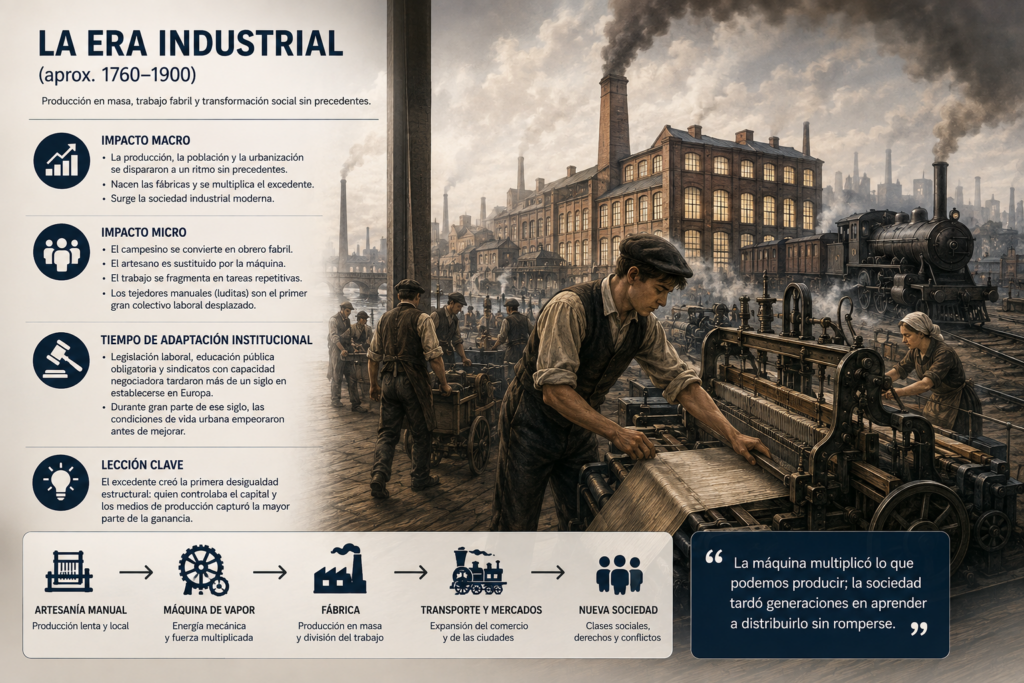
Figure — The Industrial Era (approx. 1760–1900): the machine multiplied what we could produce; society took generations to learn how to distribute it without breaking.
The information era (approx. 1950–1995).
Macro: the computer multiplied the entire economy’s capacity for calculation and communication.
Micro: switchboard operators, typists, calculators, and archivists saw their trades reduced to residual status in barely two decades — a pace of forced adaptation much faster than the industrial era, with much less generational time to absorb it.

Figure — The Information Era: when information stopped having borders. From paper files to typists, personal computers, the internet, and borderless information.
The knowledge era (approx. 1995–2020).
Macro: the internet reorganized the world’s economic geography.
Micro: travel agents, retail stockbrokers, neighborhood bookstores — pure intermediation trades disappeared not for lack of need, but because the network connected producer directly to consumer.
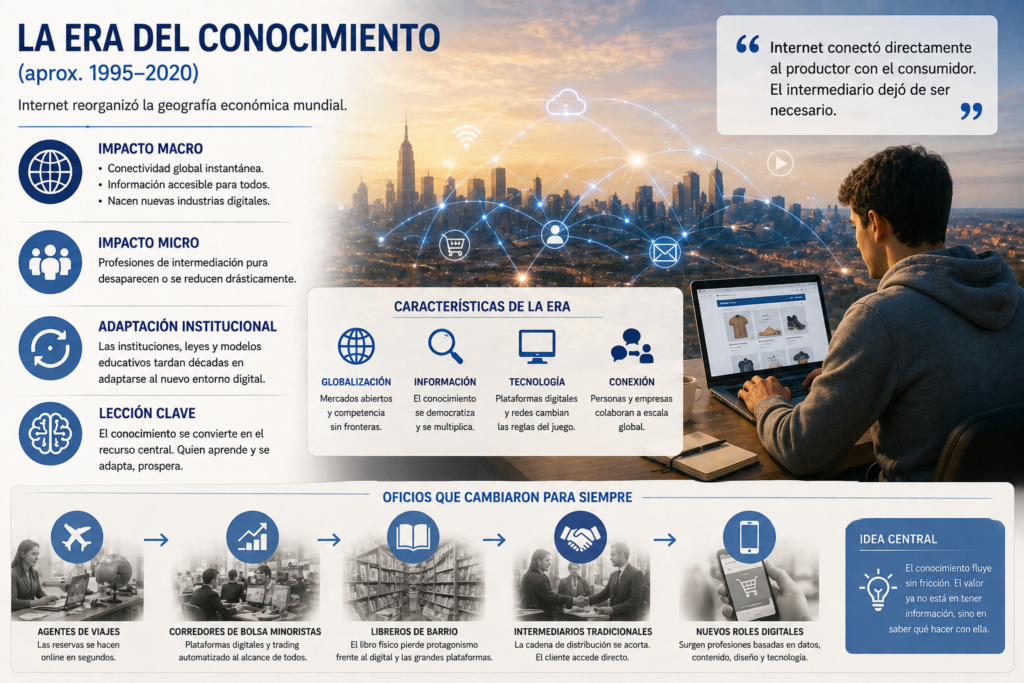
Figure — The Knowledge Era (approx. 1995–2020): the internet connected producer directly to consumer; intermediary trades faded.
The artificial intelligence era (2020–present).
Macro: by 2030, an estimated 92 million jobs will be displaced globally while 170 million are created — a net positive of 78 million.
Micro: 39% of today’s core workforce skills will become obsolete over the same period.
And the pattern repeats with historical precision: those already at a structural disadvantage are also the most exposed to displacement, and the least represented among the jobs the wave itself creates.
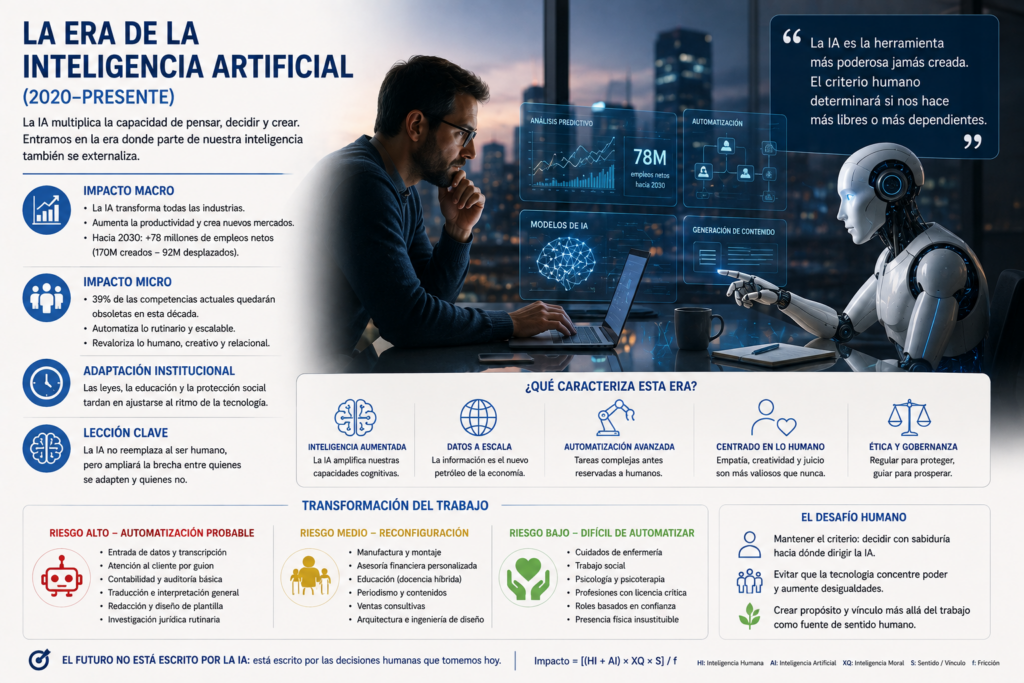
Figure — The Age of Artificial Intelligence (2020–present): augmented intelligence, data at scale, advanced automation, human-centered work, ethics and governance.
Bill Gates, co-founder of Microsoft, put a number on that speed: within ten years, most human tasks will be able to be performed by artificial intelligence. It’s confirmation, from inside the industry itself, that we’re not talking about a distant hypothesis but a window that’s already open. But Gates’s projection measures the what — not the for whom, nor the at what cost.
The psychological price — what the aggregate numbers don’t show.
Back in 1970, a thinker studying the social impact of technological change coined a term for something conventional economics barely measured: «future shock.»
His central diagnosis remains uncomfortably relevant: external acceleration translates into internal acceleration. And institutions designed for a slower pace of change — the family, education, the linear career — begin to crack under a speed they weren’t built for.
It’s no coincidence that book was written during the transition from the industrial era to the information era.
It’s exactly the same friction described today under a different name — AI-related job anxiety, skills obsolescence — but underneath, it’s the same psychological phenomenon documented more than fifty years ago.
III. What Has Already Been Lost — The Historical Precedent
The table below shouldn’t be read as a linear scale: each wave coexists with very different timeframes — a century and a half for the peasantry, five years and counting for data entry.
That progressive contraction is, in itself, the data point that matters. It isn’t that each trade takes the same time to disappear; it’s that each wave has less time than the last to do it, while humanity’s capacity to rebuild institutions doesn’t accelerate at the same pace. That, precisely, is where the friction is born.
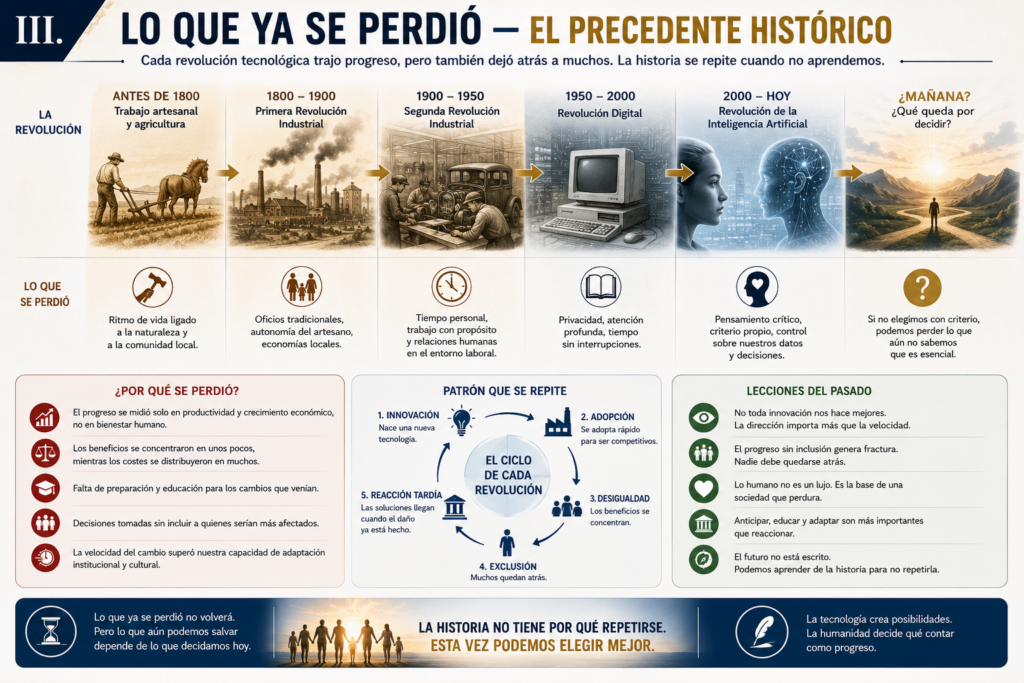
Figure — What Has Already Been Lost: the historical precedent, from pre-1800 craftwork to the AI revolution, and the five-stage cycle each revolution repeats.
- Agricultural → Industrial: the peasantry, once the majority of the workforce (from ~90% down to 2% in developed countries), was replaced by agricultural mechanization and the factory. Approximate time: ~150 years.
- Industrial: the hand weaver and textile artisan was replaced by the mechanical loom. Approximate time: ~30 years.
- Industrial → Information: the elevator operator and switchboard operator were replaced by electromechanical automation. Approximate time: ~20 years.
- Information: the typist, the calculator, and the office archivist were replaced by the personal computer. Approximate time: ~15 years.
- Knowledge: the retail travel agent, the street-level stockbroker, and the video store were replaced by the internet and direct platforms. Approximate time: ~10 years.
- AI (ongoing): data entry, basic content moderation, and routine legal research are being replaced by language models. Approximate time: ~5 years, ongoing.
The pattern is visible without needing advanced statistics: each wave takes less time than the one before it to displace a trade.
Institutional adaptation capacity, by contrast, hasn’t accelerated at the same rate. And that, precisely, is where the friction is born — friction each generation experiences as a new crisis, when in reality it’s the same gap, simply with less and less available time each round.
IV. Twenty Sectors Facing the AI Wave
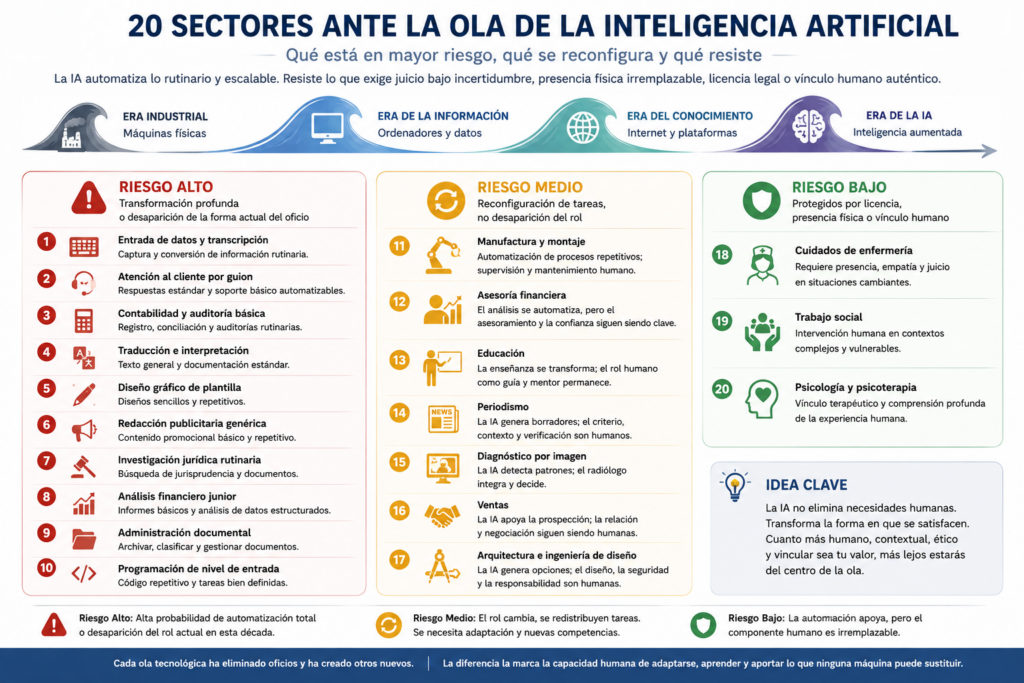
Figure — Twenty Sectors Facing the AI Wave: what’s at highest risk, what’s being reconfigured, and what resists.
High risk — deep transformation or disappearance of the trade’s current form:
Data entry and transcription, scripted customer service, basic accounting and auditing, general text translation and interpretation, template graphic design, generic advertising copywriting, routine legal research, junior financial analysis, office document administration, entry-level programming.
Medium risk — reconfiguration of tasks, not disappearance of the role:
Manufacturing and assembly, client-facing financial advising, education, journalism, diagnostic imaging, sales, architecture and design engineering.
Low risk — protected by license, physical presence, or an irreducible human bond:
Nursing, social work, psychology and psychotherapy.
The pattern that emerges isn’t «manual versus intellectual,» as was believed a decade ago, but something more precise: what gets automated is what’s routine and scalable.
What resists is what demands judgment under uncertainty, irreplaceable physical presence, legal license, or a trust relationship between two specific people.
Nursing and psychology aren’t spared because they’re «more human» in some romantic sense. They’re spared because their value depends on a bond that none of the previous four waves managed to automate either.
V. The Biological Comparison: What DNA Can Teach Us About Adapting
Here it’s worth stepping back and looking beyond human history, because biology offers a very useful contrast.
Genetic evolution — the mechanism by which insects, animals, and plants adapt — operates through natural selection across generations.
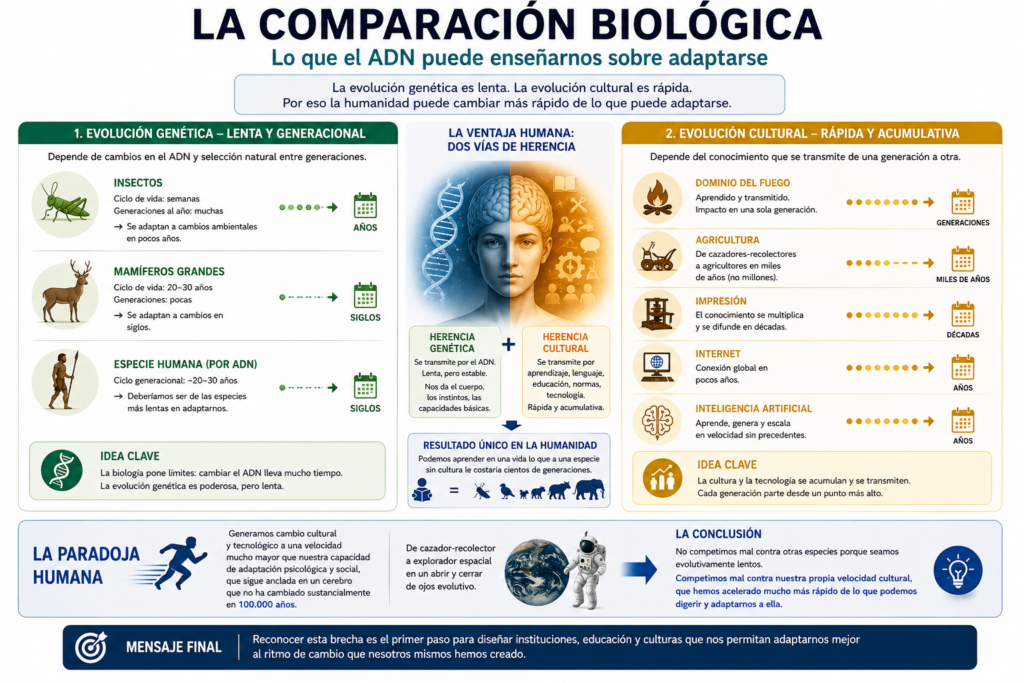
Figure — The Biological Comparison: genetic evolution is slow and generational; cultural evolution is fast and cumulative — humanity’s dual inheritance advantage.
An insect with a lifecycle of weeks can adapt to an environmental change in just a few years because it has so many generations available.
A large mammal, with generations spanning twenty or thirty years, takes centuries to achieve the same thing through the purely genetic route.
The human species, with a long generational cycle, should — by pure biology — be among the slowest to adapt to a changing environment.
And yet it isn’t, because tens of thousands of years ago humanity developed a second inheritance system running in parallel to the genetic one: cultural evolution.
This is knowledge, norms, techniques passed from one generation to the next without waiting for a change in DNA.
Evolutionary biologists have described it as a second, much faster pathway of inheritance — one that lets a single human generation learn in a lifetime what a species without culture would need hundreds of generations to learn.
It’s precisely that speed that explains how humanity went from hunter-gatherer to space explorer in the blink of an evolutionary eye.
And it is, at the same time, the exact source of the problem we’ve been describing: our capacity to generate cultural and technological change runs far faster than our capacity for psychological and social adaptation, which remains tied, at bottom, to a brain that hasn’t changed substantially in a hundred thousand years.
Put differently: we don’t compete poorly against an insect because we’re evolutionarily slow. We compete poorly against our own cultural speed, which we’ve accelerated far faster than we’ve accelerated our capacity to digest the change that speed itself produces.
VI. Speculating Eighty Years Ahead — A Society Without the Growth We’ve Always Known
If the AI wave follows the installation-and-deployment rhythm documented in previous waves, by the year 2100 it’s reasonable to speculate about a society where GDP growth stops being the central measure of wellbeing.
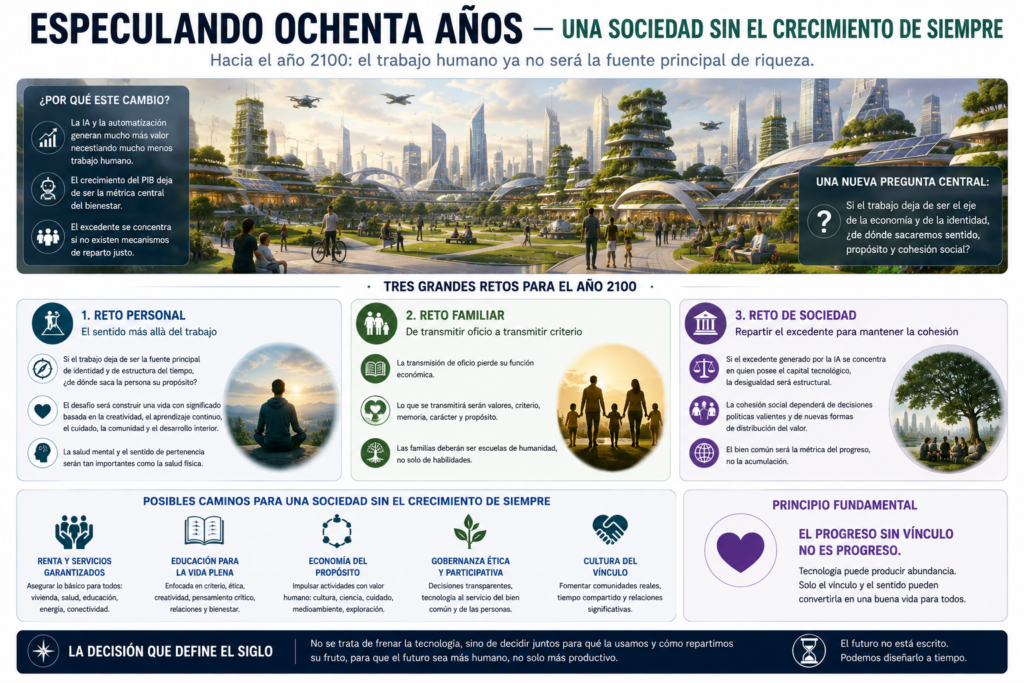
Figure — Speculating Eighty Years Ahead: personal, family, and societal challenges toward 2100, and possible paths for a society beyond conventional growth.
Simply because a growing share of production no longer requires proportionally more human labor to generate it. The challenges this raises are personal, familial, and societal, in that order.
Personal.
If work stops being the primary source of identity and the structure of time — as it has been since the industrial revolution — where does a person draw their sense of purpose?
Familial.
The transmission of a trade from one generation to the next, which sustained family structure for millennia, loses its economic function. What’s left to pass on is judgment, character, memory — not the trade, but the reason behind the trade.
Societal.
If the surplus AI generates concentrates in whoever owns the technological capital rather than whoever works — as current evidence already suggests — the society of 2100 will stake its cohesion on a single political decision: how that surplus is distributed.
Agricultural history already taught us what happens when surplus concentrates without a redistribution mechanism: inequality becomes structural, not cyclical.
VII. A Formula for Thinking About the Problem — and the Term It’s Missing
Extended Impact Formula — Tom Dean Story
Developed from the framework presented in TMC Framework 2025 – The Human System for the Age of Artificial Intelligence, where technology, ethics, humanity, and friction reduction are part of the same argument.
In 2025, various formulations circulated across strategy and change-management circles attempting to capture, in a single expression, how sustainable impact is generated within a system — human, corporate, or social.
One can be written like this:
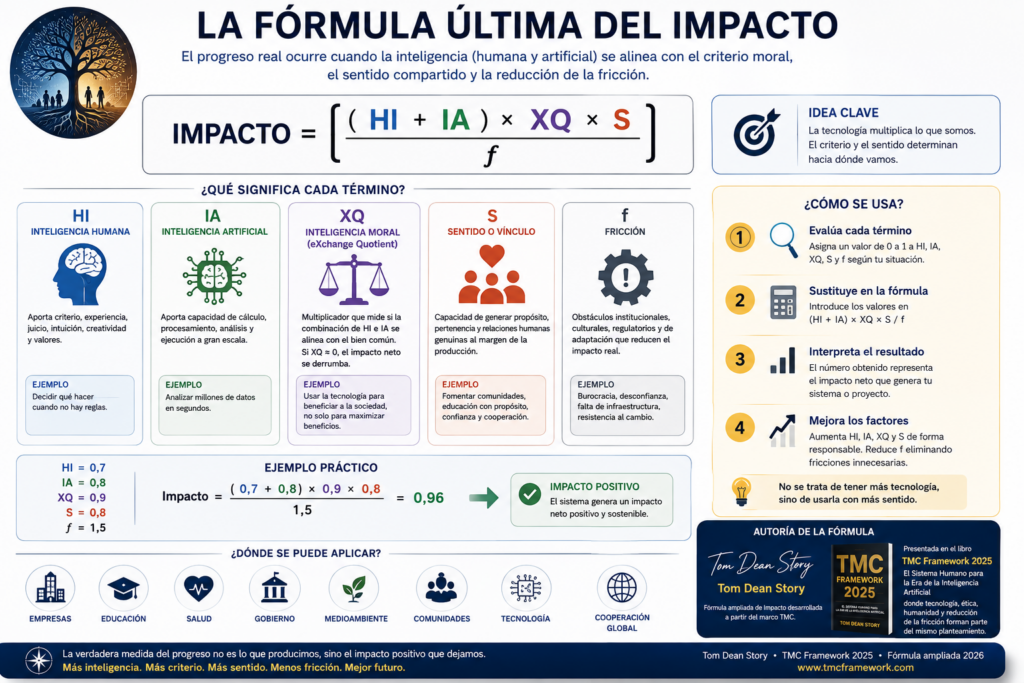
Figure — The Ultimate Impact Formula: Impact = [(HI + AI) × XQ × S] / f, with each term’s meaning, a worked example, application areas, and authorship.
Where:
- I — the Impact a system generates: the net result, positive or negative, of applying intelligence to a problem.
- HI — Human Intelligence: judgment, experience, discernment, intuition — everything a person who decides brings to the table.
- AI — Artificial Intelligence: the calculation, processing, and execution capacity the machine brings.
- XQ — Moral Intelligence (eXchange Quotient, or ethical alignment coefficient): the factor that determines whether that combination of intelligences moves toward the common good or toward concentration and harm.
It’s a multiplier, not a sum: with XQ near zero, it doesn’t matter how much combined intelligence exists — net impact collapses.
AI governance isn’t just a technical question — it’s a question of trust. The algorithms that reproduced gender bias, the facial recognition systems that performed worse for certain groups, didn’t fail only in the code — they failed in who was in the room when the decisions were made. XQ isn’t measured by how sophisticated the model is, but by the diversity of the questions someone dared to ask before training it.
- f — Friction: the institutional, cultural, regulatory, and adaptive obstacles the system encounters along the way. Dividing by f means a system with high friction sees its impact reduced even when HI, AI, and XQ are all high.
Applied to the two hundred years we’ve just traced, the logic holds up well.
HI and AI add together because they collaborate — human intelligence decides what to ask, artificial intelligence accelerates the answer.
XQ multiplies because it determines whether that potential becomes shared benefit or destructive concentration.
And f divides because the institutional adaptation time documented in every revolution is, literally, what slows down the impact the technology already has the capacity to generate.
It’s the same equation explaining why the mechanical loom and artificial intelligence produce such different results depending on the country, sector, or decade. Not because of the technology itself, but because of how these four factors combine in each specific case.
But looking a hundred years out, that formula probably needs a fifth term.
Because I explains how much impact a system generates and how well it’s distributed — not where a person draws meaning once human intelligence no longer needs to be employed full-time to generate economic value.
The extended formula would read:
Impact = [(HI + AI) × XQ × S] / f
Where S stands for Meaning — Sentido, in the original Spanish, sometimes rendered as Bond or Connection: a society’s capacity to generate purpose, belonging, and genuine human relationship independent of production.
That capacity isn’t abstract. It’s made of three concrete layers: a people’s cultural identity — its language, its symbols, its shared stories; its idiosyncrasia — the unwritten rules of trust and everyday conduct that hold a community together without needing a contract; and its intergenerational principles — what one generation decides to pass on to the next, beyond the trade itself. Where these three layers run deep, S is high. Where they’ve eroded, S falls — and with it, a society’s capacity to absorb the shock without fracturing.
Like XQ, it enters as a multiplier — because, like XQ, its absence doesn’t reduce impact: it erases it.
This extended form is born from a single question: What happens if we manage to produce far more while needing far less human labor, but work was precisely one of the structures that provided identity, relationships, recognition, and purpose?
This term isn’t a decorative addition to the formula — of the five variables, it’s the only one not measured in units of production.
Intelligence, human or artificial, multiplies. Institutional friction gets documented in years of delay. But meaning doesn’t grow just because there’s more of it circulating.
It grows or degrades depending on whether the structures that once generated it automatically — the shared trade, the guild, the family table organized around a common livelihood — still exist or not.
The previous four waves eroded trades without yet eroding the very source of the bond: work changed shape, but it kept being the place where a person encountered others, measured their worth against a group, inherited and passed down meaning.
What’s different about the AI wave, if it truly reduces the human time needed to produce value, is that for the first time it threatens that very source — not just its form.
That’s why the term acts as a multiplier and not an addition: without meaning and bond, no level of combined intelligence or institutional morality sustains a society where work, as it’s been known for ten thousand years, stops being the backbone of human life.
Deliberately rebuilding those sources of connection — not as a byproduct of economic progress, but as an explicit project running alongside it — may be, of all the tasks this century demands, the least technical and the most urgent.
VIII. What You Can Do, Today, Within This Wave
Everything above is diagnosis. And diagnosis, by itself, protects no one.
So bring your gaze down from eighty years to the eight you actually have ahead of you: within your own trade, what distinguishes the part the wave has already reached from the part that’s still yours?
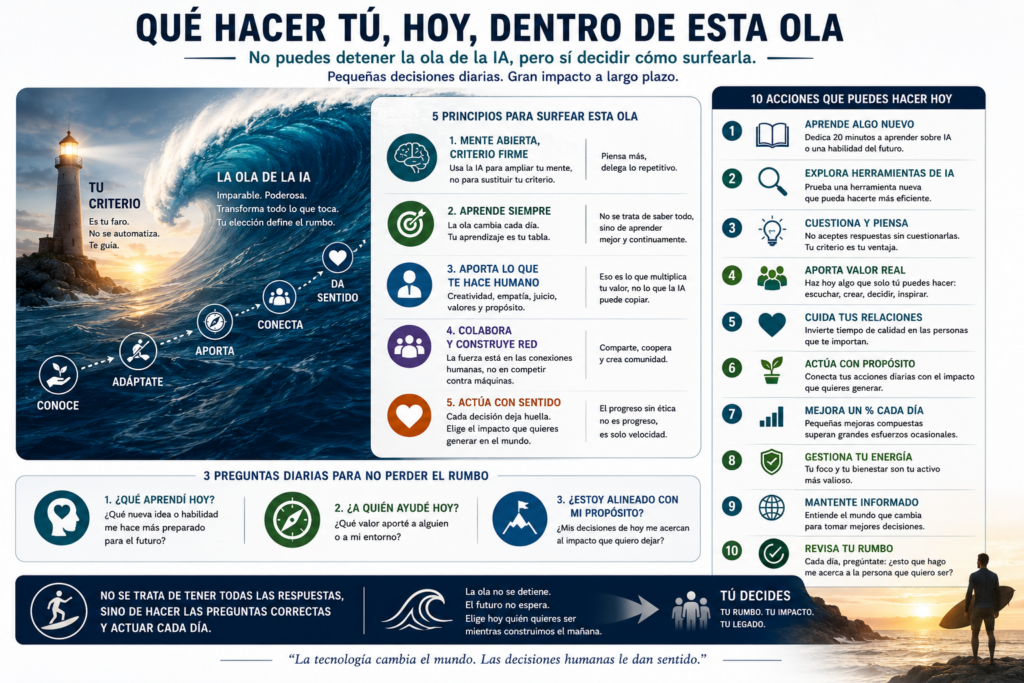
Figure — What You Can Do, Today, Within This Wave: five principles for riding the wave, ten actions for today, and three daily questions to stay on course.
Section IV already gave the answer without naming it as such: what survives isn’t an entire profession, but a specific set of capabilities within it.
It isn’t «nurse» or «lawyer»; it’s the nurse who decides in the room when the protocol doesn’t cover the case, versus the administrative assistant who only ever applied the protocol. The difference was never the title. It was, and still is, this:
Judgment under uncertainty.
Does your work involve applying a known rule to a known case, or deciding what to do when the rule isn’t enough? The former gets automated first — it always has, since the loom.
Irreplaceable presence.
Does someone need you, physically, in that place, with that body — or do they just need the result of what you produce? The latter travels; the former doesn’t.
License or real legal responsibility.
Do you sign something that makes you accountable to another human being or to the law, beyond having simply executed a task well? Responsibility can’t be delegated to a model, even when the model does the work.
Trust built over time.
Is there someone who returns to you — client, patient, student, reader — because they know you, not because you’re the cheapest option available? That return is the hardest thing to replicate, and the last thing to be automated.
The more of these four questions you can answer with an unqualified yes, the further you stand from the center of the wave.
The more you answer with an uncomfortable «actually, no» — that, exactly there, is the part of your trade worth starting to rebuild now, not once the wave arrives.
And there’s a fifth consideration, which doesn’t come from Section IV but from the extended formula in Section VII, and which probably matters more than the other four combined over the long run.
Section VI left a question open at the level of society: where does a person draw their sense of purpose once work stops organizing their time?
At the personal level, the answer doesn’t begin with another question, but with an action: name, today, a relationship, a practice, or a community that doesn’t depend on your productivity — and protect it with the same discipline you’d use to protect an income.
That question sounds personal, but it isn’t answered alone. The reason to get up on a Tuesday isn’t invented from scratch each morning — it’s inherited from a culture that already decided, generations back, what’s worth holding on to. An individual can name their bond. But it’s a society, through its high or low S, that determines whether that bond is easy to find or a solitary search.
The first four questions protect you from displacement this decade. This fifth consideration decides whether, once old age or retirement finally arrives and work no longer organizes your days, you still have a reason to get up in the morning.
That doesn’t get automated, and it doesn’t get answered in the abstract — it gets built, starting today, without waiting for any wave.
Closing — the thread, once more
Each of the waves we’ve traced — agricultural, industrial, information, knowledge, artificial intelligence — repeats the same three-act sequence.
A technology multiplies what a human being can produce.
Society takes generations to rebuild its institutions to absorb that change without breaking. And those who were already at a disadvantage when the wave began are, almost always, the ones who take longest to cross to the other side.
It isn’t a human flaw — it is, seen with the distance biology offers, the price of having a cultural speed that runs far faster than our psychological speed of adaptation.
The question that really matters, then, isn’t whether artificial intelligence is going to change everything — we already know that; every technology has, since the plow.
The question is whether this time we’ll recognize the pattern in time to shorten the period of friction, or whether, as in every wave before, we’ll let a crisis force us to learn what history had already taught us.
The wave is already here. The only question that truly depends on you is whether, when it’s your turn to cross it, you’ll know what to hold on to.
Section IX. Toward a Less Capitalist, More Social Society?
If the trajectory described so far continues over the coming decades, it’s reasonable to ask whether, thirty or forty years from now, society will be less capitalist in its current form and considerably more social in its distribution. Not necessarily toward traditional socialism.
Perhaps toward something different: a capitalism forced to transform in order to keep functioning.
Contemporary capitalism rests on a relatively simple circuit: work → wages → consumption → profits → investment → more work.
Artificial intelligence may progressively weaken the first link.
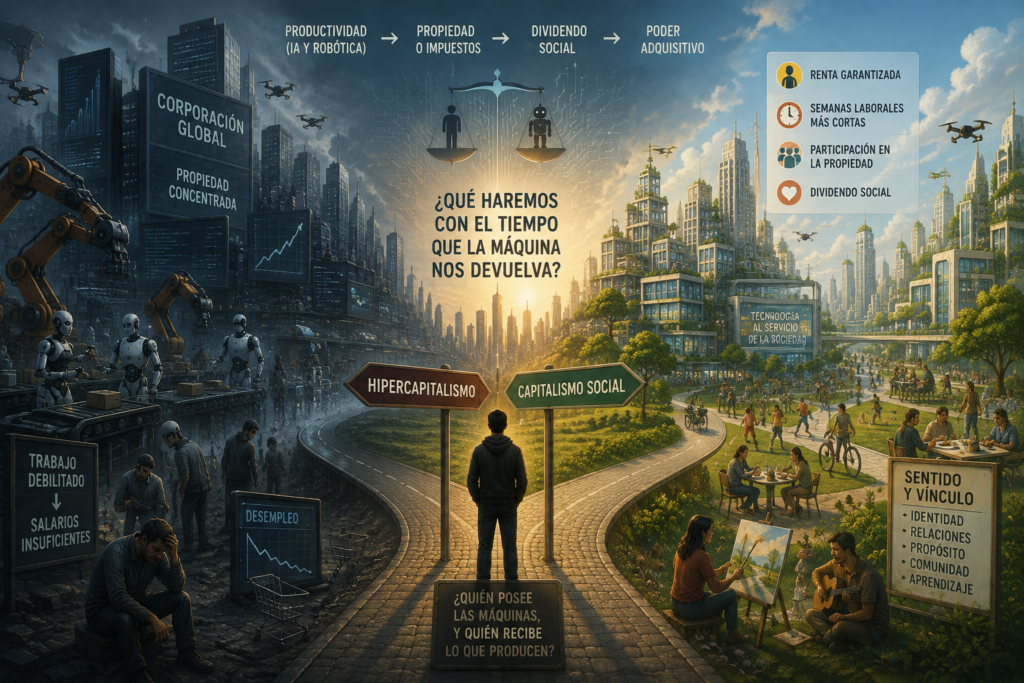
Figure — Two paths from 2060: hypercapitalism (concentrated ownership, weakened work, insufficient wages) versus social capitalism (guaranteed income, shorter workweeks, ownership participation, social dividend, meaning and bond).
Imagine the year 2060. There’s no need to imagine a society without human work — it’s enough that AI and robotics allow us to produce two or three times more while using far fewer of our hours.
That’s where the contradiction appears: enormous productive capacity, insufficient wage income to buy what’s produced.
Machines can manufacture, calculate, design. But machines don’t buy homes, don’t travel, don’t sit down to dinner with anyone.
From that contradiction, two very different futures could emerge.
The first: a hypercapitalism where ownership of AI concentrates in very few hands, productivity rises, and labor’s bargaining power disappears. Progress turned into concentration.
It’s one of the risks this same thread has been pointing to since its first act.
The second: a social capitalism, where private property continues to exist but society accepts that, if work stops being the main source of value, access to wealth can no longer depend exclusively on holding a job.
Guaranteed income, shorter workweeks, worker ownership stakes, some form of social dividend — the specific mechanisms matter less than the question underneath them: Who owns the machines, and who receives what they produce?
But a social dividend without S is hypercapitalism with anesthesia: it solves the wallet and leaves the question that actually matters untouched. Money can be redistributed by decree. Meaning can’t. That’s why S multiplies in the formula instead of adding — a society can distribute its surplus with perfect fairness and still hollow out from within, if no one tends, at the same time, to what gives a people its shape.
Previous revolutions needed forty to sixty years to complete their institutional adaptation. If we place the start of this one around 2020, the period between 2050 and 2080 could be the great era of reconstruction.
No longer the usual question — how do we create enough jobs? — but a different one: Why do we need conventional employment to participate in a society capable of producing abundance with steadily less human labor?
But the hardest problem won’t be economic.
Here, S — Meaning — returns.
Because work hasn’t only distributed wages: it has distributed identity, relationships, structure of time, purpose.
The material problem has, in theory, a comprehensible mechanism: productivity → ownership or taxation → social dividend → purchasing power.
But immediately comes the question no mechanism resolves on its own: if work stops organizing our existence, what organizes a Tuesday morning?
It’s the same thread running through this entire essay. Technology creates a surplus. Ownership tends to concentrate it.
The tension grows. Institutions, sooner or later, react. It has happened after every revolution — agricultural, industrial, technological.
The difference this time is that the worker might not automatically find another place in the productive system, because wages themselves might stop being the mechanism through which wealth returns to society.
The question would no longer be whether capitalism disappears. It would be another one: what happens to capitalism when human labor stops being the mechanism that distributes the wealth capitalism itself generates?
If that situation arrives, it probably won’t mean the end of markets or private property.
It will mean a system still capitalist in its capacity to create, more social in how it distributes its results, and forced — for the first time — to find a source of human meaning that doesn’t depend on work.
Perhaps that will be one of the biggest shifts since the Industrial Revolution. And perhaps the question that truly matters isn’t economic at all, but this: what will we do with the time the machine gives back to us?
Sources Consulted
Prados de la Escosura (historical national accounts of Spain);
World Economic Forum, Future of Jobs Report 2025; McKinsey Global Institute; Forecasting Research Institute, «Forecasting the Economic Effects of AI» (2026);
World Bank, Global Economic Prospects (June 2026); Jackson & Kanik, «The Economic Benefits and Costs of AI» (2026);
Carlota Pérez, «Technological Revolutions and Financial Capital» and «Technological Revolutions and Techno-Economic Paradigms» (Cambridge Journal of Economics, 2010);
Alvin Toffler, «Future Shock» (1970); literature on Kondratiev long waves and gene-culture coevolution.
The formula by Tom Dean Story in TMC — Human Framework for the Age of Artificial Intelligence, 2025.
Transparency Note
On the making of «The Thread of Growth: From Hunter-Gatherers to Artificial Intelligence»
This essay applies its own formula to itself. Below is the breakdown of contributions between Human Intelligence (HI) and Artificial Intelligence (AI) in its creation process, with XQ and S as the factors that made it possible for both to work together without one replacing the other.
HI — Human Intelligence (Tom Dean Story)
Responsibility: authorship, judgment, and purpose.
- The essay’s central thesis — that every technological revolution repeats the same three-act sequence, and that recognizing the pattern in time is the only real advantage one generation has over another.
- The complete eight-movement structure, including the decision to close with a section addressed directly to the reader.
- The original Impact formula and its later extension with the S term (Meaning) — the idea that the formula needed a fifth term didn’t come from technical analysis, but from the author himself noticing a conceptual gap.
- The editorial judgment behind every revision: what to develop, what to cut, and the constant discernment of when a sentence sounded foreign to the author’s voice and needed rewriting.
- The underlying decision that the essay had to be useful to someone specific, not just describe a phenomenon.
AI — Artificial Intelligence
Responsibility: verification, execution, and technical precision.
- Cross-checking the cited figures (World Economic Forum, Forecasting Research Institute) against primary sources, confirming their existence and accuracy before they were stated in the text.
- Drafting the prose for ideas already defined by the author, following his style and register.
- Formalizing the formula in mathematical notation and organizing the glossary of terms.
- Executing precision adjustments flagged by the author: the bridging sentence before the historical table, the rhetorical question introducing the S term, typo corrections.
No structural, argumentative, or conceptual element of the essay originated with the AI without first coming from an indication or intuition from the author.
XQ — Moral Intelligence (the alignment factor)
This showed up in the process itself: no figure was accepted as valid without checking it against a primary source, no argument was inflated beyond what the evidence supports, and no decision that actually belonged to the author was ever attributed to the AI.
S — Meaning (what neither intelligence provides alone)
The essay means something to the reader because the author decided, before writing a single line, that it had to serve someone real — someone asking, «and how does this help me?» That decision isn’t verified or drafted: it’s made.
AI can execute a section of the essay; it cannot want it to exist.
This note is published as a transparency practice regarding the use of artificial intelligence tools in the editorial process, consistent with the TMC framework developed in this same essay.
Tommy Dean Story
All rights reserved 2026 (c)